Global context
A U-Net encoder–decoder captures scene geometry across scales. Skip connections recover spatial information lost during pooling.
Robotic perception · arXiv:2510.04883v2
Clarity-Enhanced Active Reconstruction of Infrared Imagery for low-light enhancement
See objects. Read markers. Track motion. Even when visible light fades.
The University of Manchester · United Kingdom
¹ Mean enhancement latency reported in Table II; not end-to-end SLAM runtime.
The idea
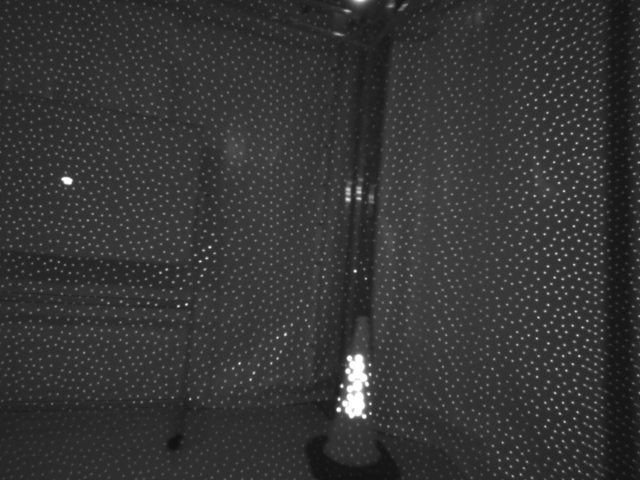
Active infrared can see through darkness. Its projected dot pattern gets in the way of understanding what it sees.
This paper presents a novel approach for enabling robust robotic perception in dark environments using infrared (IR) stream. IR stream is less susceptible to noise than RGB in low-light conditions. However, it is dominated by active emitter patterns that hinder high-level tasks such as object detection, tracking and localisation. To address this, a Deep Multi-scale Aware Overcomplete (DeepMAO) inspired architecture is proposed that reconstructs clean IR images from emitter populated input, improving both image quality and downstream robotic performance. This approach outperforms existing enhancement techniques and enables reliable operation of vision driven robotic systems across illumination conditions from well-lit to extreme low-light scenes. The results outline the ability of this work to be able to mimic RGB styling from the scene and its applicability on robotics tasks that were trained on RGB images, opening the possibility of doing these tasks in extreme low-light without on-board lighting.
Watch the research in action
The IROS research video shows the motivation, reconstruction method, object detections, and odometry comparisons.
The video contrasts dark RGB and patterned raw IR with CLEAR-IR, then shows object detections and motion estimation. Portions are accelerated, as marked in the video. Download video (7.7 MB).
See the difference
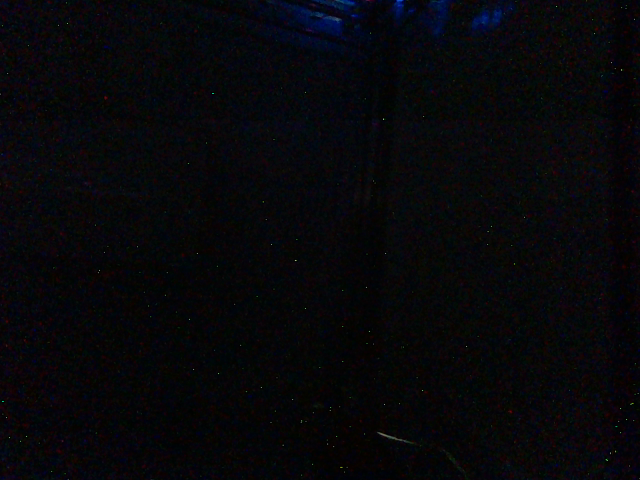
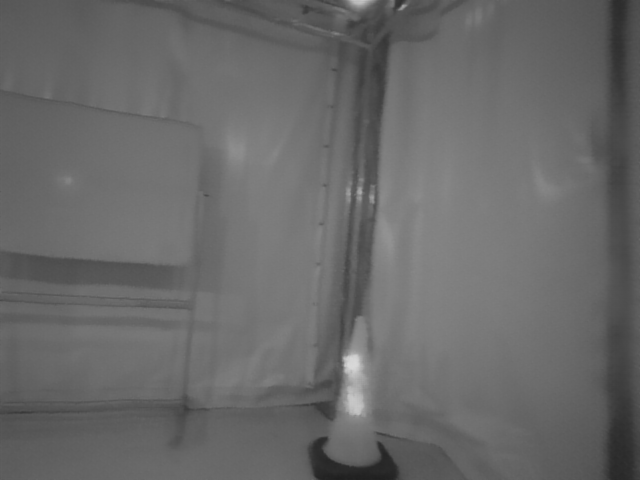
Compare the paper’s reconstruction with raw IR and visible-light enhancement baselines.
How it works
A dual-stream network inspired by DeepMAO brings global structure and fine spatial detail back together.
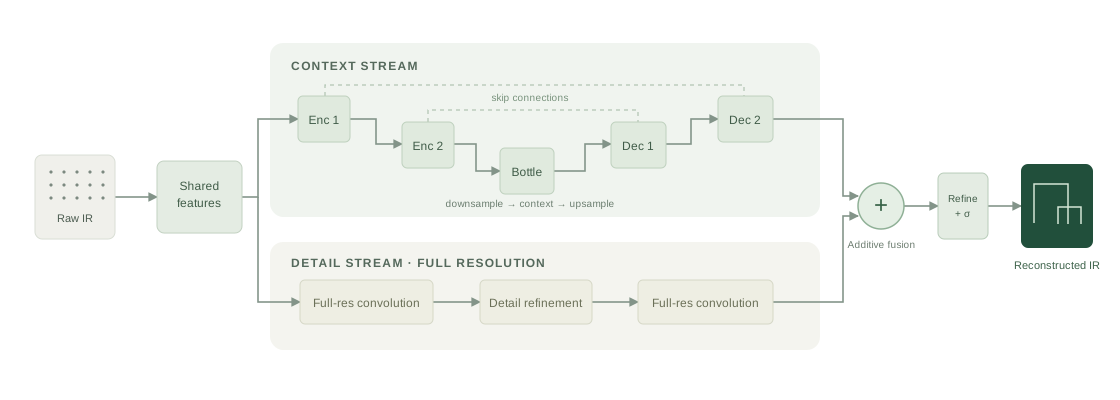
A U-Net encoder–decoder captures scene geometry across scales. Skip connections recover spatial information lost during pooling.
An overcomplete branch keeps the original spatial grid, preserving meaningful boundaries and texture while suppressing emitter artefacts.
Intensity, structural, edge, perceptual, and regularisation losses accommodate the spectral gap between IR inputs and RGB-style targets.
Trained on 6,719 captured IR/RGB pairs, expanded to 33,595 images through augmentation, using a 90/10 training-validation split.
What does cleaner IR make possible?
Choose a task to see the evidence. These are examples and measurements from the paper, rather than a live inference demo.
Readable markers
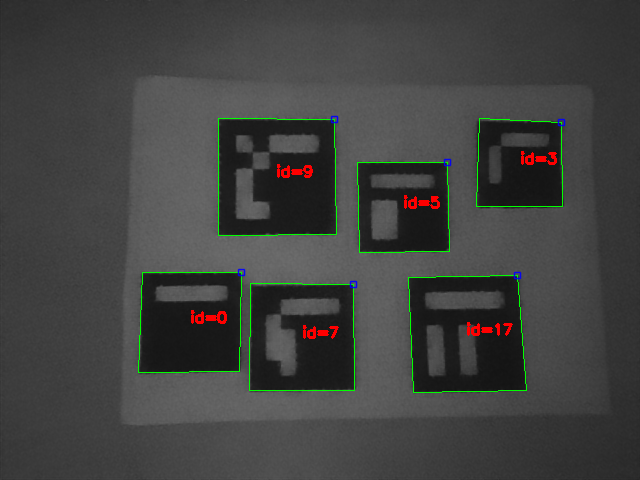
Emitter dots interrupt the black-and-white pattern of standard ArUco markers. Reconstruction makes those boundaries readable without specialised reflective tags.
Counts from the evaluated example in Table I; not a dataset-wide detection rate.
Read the marker experiment ↗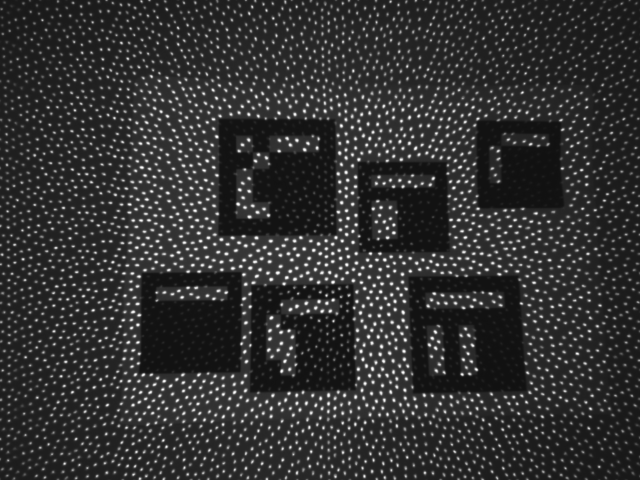
Visual localisation
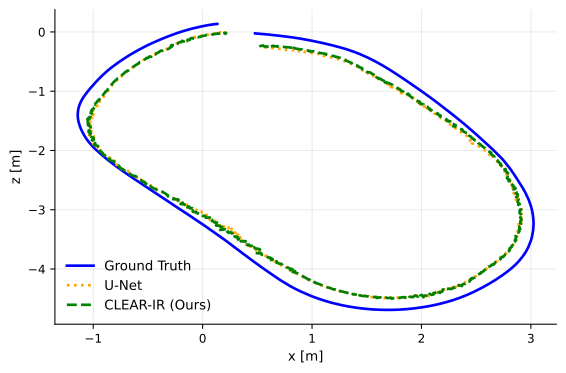
CLEAR-IR feeds reconstructed images into a modified ORB-SLAM3 pipeline with SuperPoint features and L2 descriptor matching.
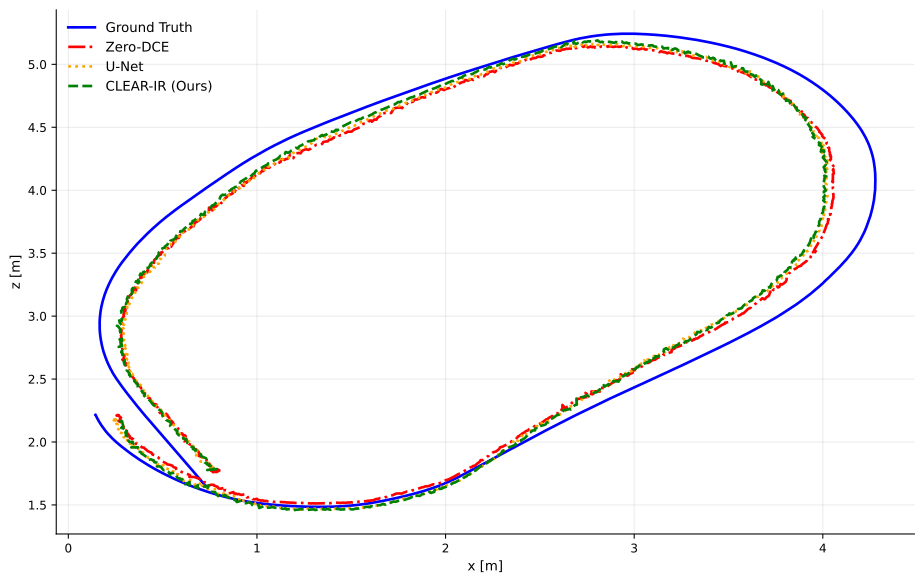
Trajectory RMSE in metres ↓ · mean ± standard deviation
Trajectory RMSE in metres; shorter bars indicate lower error. “Did not initialise” means no trajectory was produced.
| Method | FB | SQ1 | SQ2 | Inference ms |
|---|
Extreme low light: RGB enhancement baselines fail to initialise; reconstructed IR supports SLAM across all three sequences.
DNI = did not initialise. Results from Table II; inference is enhancement latency, not the whole SLAM pipeline. Evaluation details ↗
Explore the work
Read the full method and evaluation, or run the public CLEAR-IR model and IR-D SLAM pipeline on the recorded evaluation sequences.
Try it on a recorded sequence
After installing dependencies and building DarkSLAM, run these commands from its repository root. Choose a sequence and compare reconstructed IR with the raw-IR baseline.
Git LFS is required for the dataset. The clone step is needed once. Evaluation uses measured depth and Vicon ground truth; --plot saves the estimated trajectory against ground truth with fixed-scale SE(3) alignment. Choose a fresh output directory for each run. A short run checks execution rather than full-sequence accuracy. Runtime depends on your hardware; the 46.75 ms reported above measures enhancement only.
Build on this work
@misc{shankar2025clearir,
  title         = {CLEAR-IR: Clarity-Enhanced Active Reconstruction of
                   Infrared Imagery for low-light enhancement},
  author        = {Nathan Shankar and Marton Gonczy and Hujun Yin
                   and Pawel Ladosz},
  year          = {2025},
  eprint        = {2510.04883},
  archivePrefix = {arXiv},
  primaryClass  = {cs.RO},
  note          = {Version 2, 27 February 2026},
  url           = {https://arxiv.org/abs/2510.04883v2}
}